Kiyosaki forecasts Bitcoin at $1 million by 2035, citing a “Greater Depression” as a wealth-building opportunity for BTC.
Bitcoin’s 2025 price could hit $145,000–$200,000, fueled by $70B in ETF inflows and U.S. Treasury liquidity.
Technical analysis shows BTC consolidating, but a breakout above $90,000 could target $150,000.
Robert Kiyosaki believes Bitcoin price could hit $1M. Graphic generated by Grok
Renowned
author Robert Kiyosaki forecasts Bitcoin (BTC) price could skyrocket to $1
million by 2035, driven by an ongoing economic crash and surging U.S. debt. As
of today (Saturday), April 19, 2025, Bitcoin’s price is up 1%, trading above $85,000, according to CoinMarketCap. Despite macroeconomic fears, ETF inflows and
bullish sentiment are pushing BTC higher.
In this
article, we dive into Kiyosaki’s bold prediction, explore the forces driving
Bitcoin’s 2025 rally, and answer the critical question: Why is Bitcoin going up
today, and how high can BTC price go in the long run?
Why Is Bitcoin Going Up
Today? BTC Price Back Above 2 Key EMAs
As of April
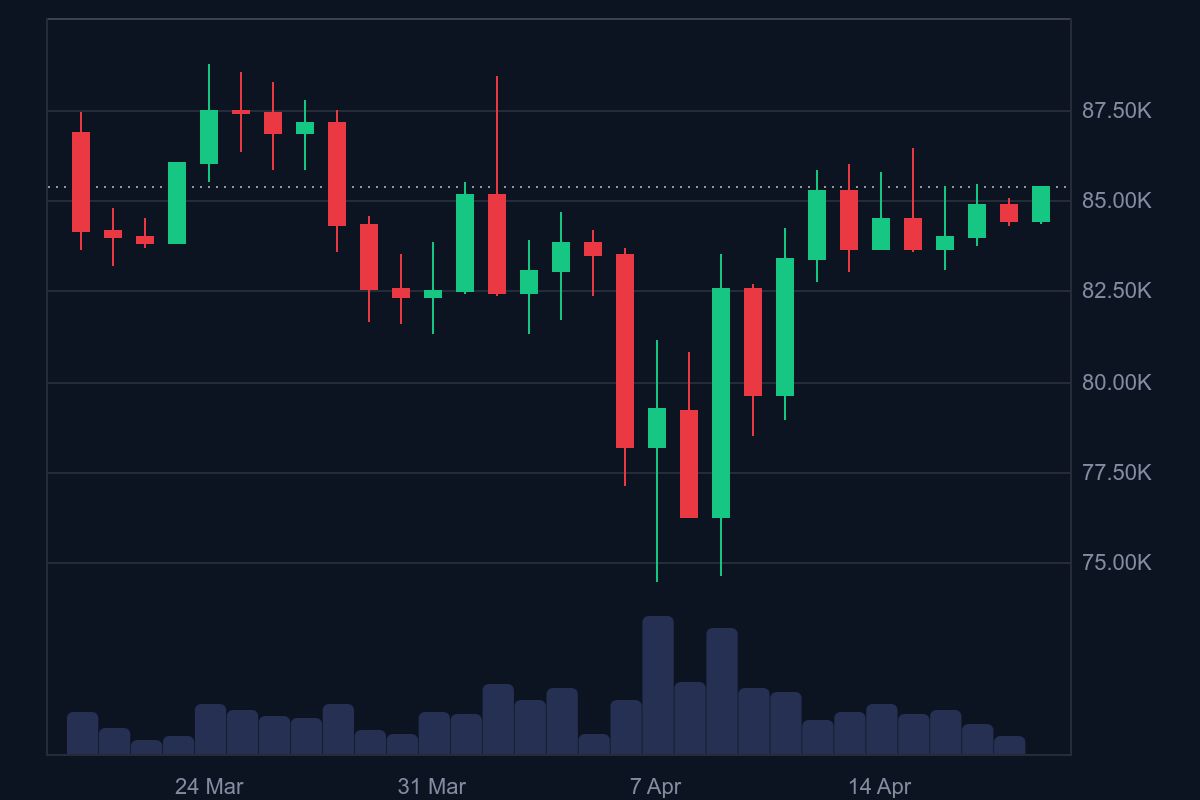
19, 2025, Bitcoin (BTC) is priced at approximately $85,419, a 1% increase compared
to the previous close and 0.9% over the past 24 hours. The total market
capitalization currently stands at nearly $1.7 trillion, with a daily trading
volume of $12.4 billion.
Bitcoin price today. Source: CoinMarketCap
However,
Robert Kiyosaki, co-author of Rich Dad Poor Dad, believes Bitcoin’s
potential is far greater, projecting a staggering $1 million valuation by 2035.
Why Will Bitcoin Surge?
Kiyosaki’s $1 Million Prediction
In a tweet
posted on April 19, 2025, Kiyosaki warned of a “Greater Depression” fueled by
record-high U.S. debt, rising unemployment, and collapsing 401(k)s. He
reiterated advice from his books, including Rich Dad Poor Dad and Rich
Dad’s Prophecy, urging investors to buy Bitcoin, gold, and silver to
weather the crisis.
MAKES ME SAD: In 2025 credit card debt is at all time highs. US debt is at all time highs. Unemployment is rising. 401 k’s are losing. Pensions are being stolen. USA may be heading for a GREATER DEPRESSION.
I get sad because as I stated in an earlier X….Tweet….I warned…
Economic Collapse as a Catalyst: Kiyosaki points to soaring
U.S. credit card debt, national debt, and pension losses, signaling a
“giant crash.” Historically, economic crises drive demand for scarce
assets like Bitcoin, which has a fixed supply of 21 million coins.
Safe-Haven Appeal: With traditional markets
faltering, Kiyosaki
sees Bitcoin as “digital gold.” Analyst Lyn Alden notes Bitcoin’s 83%
correlation with global liquidity, making it a hedge against fiat
devaluation.
Historical Precedent: Bitcoin surged 600% after the
2020 halving and 150% in 2023’s recovery. The April 2024 halving, reducing
mining rewards to 3.125 BTC, continues to tighten supply, setting the
stage for a bull run.
Market Sentiment: Despite macro fears, buy-side
liquidity on exchanges like Binance remains strong, with large investors
moving BTC to cold storage.
What’s Driving Bitcoin’s
2025 Rally?
Bitcoin’s
current uptrend isn’t just speculative. Several factors are fueling its
momentum:
ETF Inflows: Bitcoin
ETFs have attracted $60 billion in 2025, with retail investors driving
75% of flows. Bernstein analysts project $70 billion more by year-end,
potentially pushing BTC to $150,000.
Easing Macro Pressures: Recent tariff exemptions have
lowered U.S. Treasury yields, reducing headwinds for risk assets like
Bitcoin.
Monetary policy: President Donald Trump didn’t
hesitate to attack Federal Reserve Chair Jerome Powell, hinting at firing
him for “delaying” interest rate cuts
“In my
assessment, Bitcoin crossing the $84,000 threshold was not just a reaction to
Trump’s pressure on Powell; it’s the culmination of months of rising
uncertainty in traditional markets,” commented Rania Gule, Senior Market Analyst at XS.com. “High
interest rates, industrial slowdown, trade tensions, and geopolitical conflicts
are all pushing capital toward havens detached from government influence. Here,
Bitcoin emerges not as a speculative asset, as it was previously labelled, but
as a serious hedge in the eyes of major institutions.”
Bitcoin’s
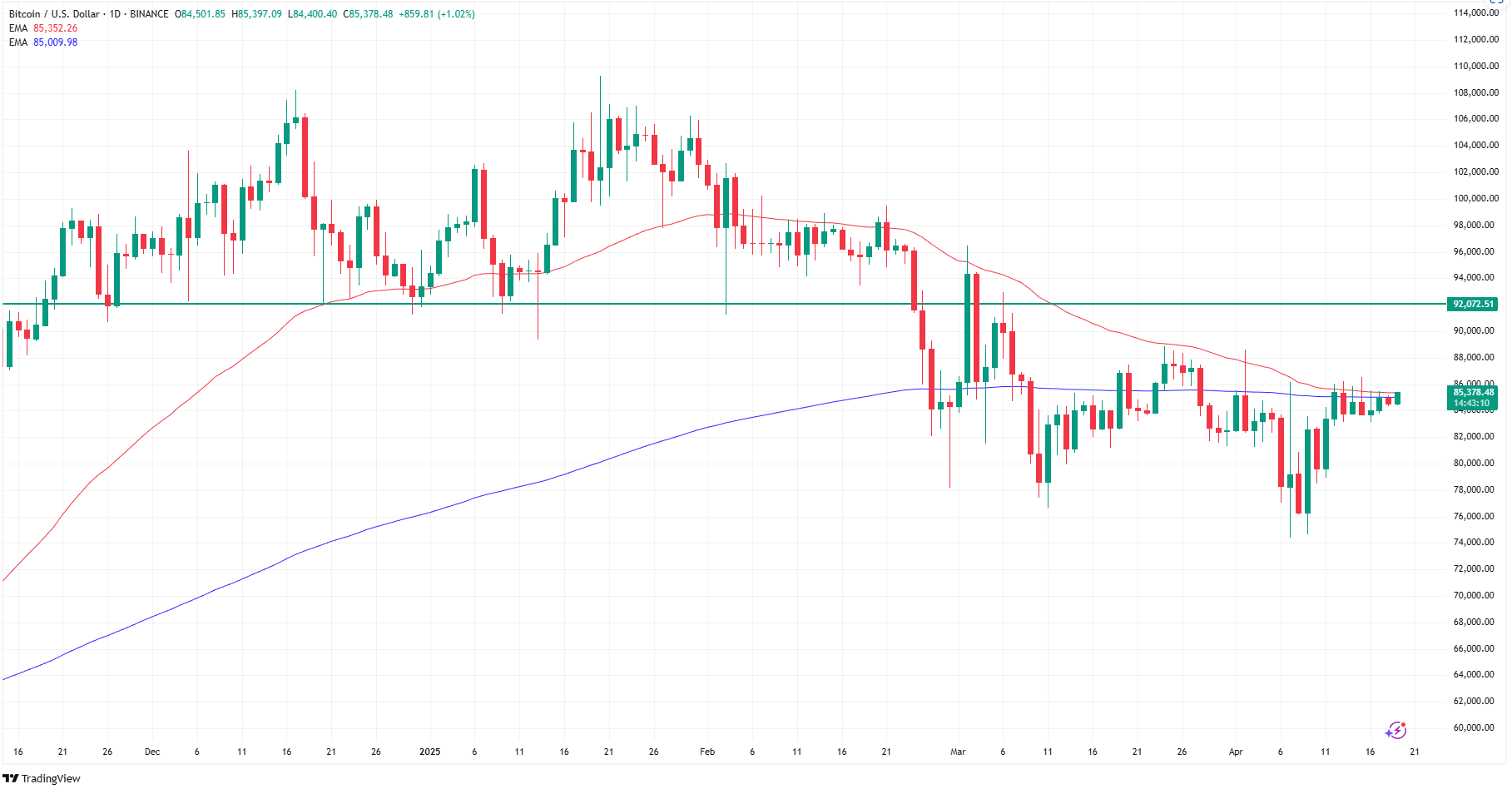
price action shows a consolidation phase since March 2025, trading between
$87,400 resistance and $78,000 support. The 50-day and 200-day exponential
moving averages (EMAs) have converged near current price levels, signaling a
potential breakout.
My
technical analysis indicates that BTC/USD is currently testing the 50 and 200
EMA levels. If the pair manages to break above them decisively—something that
hasn’t happened in many months—it could generate a strong signal for potential
upward movement.
“Bitcoin's
implied volatility is trending below 50, which is a historically low level, and
price is at the low end of the channel established since November,” said Paul
Howard, Director at Wincent. “Given the turmoil in the macro markets, the last
month hasn't brought BTC price down below 74k (pre-November 2024 levels), and
the regulatory environment is a lot friendlier. It would seem likely we see
price appreciation rather than a gap lower.”
“There
needs to be a catalyst, however, and that might not come for several months and
in my view will be driven by further policy changes in the US, notably regards
to taxation, payments and regulations (specifically on stablecoins).”
Bullish
Case: A break above
$86,000 could target:
$90,000–$92,000
(late 2024 lows)
$100,000
(psychological level)
$108,000
(December 2024 all-time high)
$150,000 (potential Q4 2025
target, per Bernstein)
Bearish
Case: A drop below
$78,000 could test:
$74,500
(April 2025 lows)
$68,000
(July 2024 highs)
$66,000
(October 2024 lows)
Support and Resistance Levels:
Support Levels
Description
Resistance Levels
Description
$78,000
Lower
consolidation boundary, tested in March 2025
$87,400
Upper
consolidation boundary, March 2025 highs
$74,500
April 2025 lows
$90,000–$92,000
Resistance from late 2024 lows
$68,000
July 2024 highs
$100,000
Psychological barrier
$66,000
October 2024 lows
$108,000
December 2024 all-time high
Bitcoin Price Predictions
for 2025 and Beyond
Kiyosaki’s
$1 million by 2035 is ambitious, but other analysts offer nearer-term
forecasts:
Kiyosaki’s
$1 million call assumes a prolonged crisis, but risks could derail Bitcoin’s
ascent:
Debt Ceiling Resolution: An early debt ceiling deal
could slow TGA drawdowns, capping liquidity at $6.3 trillion, per Tomas.
Geopolitical Tensions: Escalating global conflicts
could favor gold over Bitcoin
Technical Hurdles: Failure to break the 200-day
EMA could trap BTC below $90,000, delaying bullish momentum.
Moreover, Dr.
Kirill Kretov, Senior Automation Expert at CoinPanel, offers a more cautious
outlook. In a recent statement, Kretov warns that the bullish narrative may
overlook critical macroeconomic and market dynamics, casting doubt on a clean
breakout to six-figure prices in 2025.
“We are in
a phase of deep macro uncertainty marked by geopolitical tension, fragile
global markets, and a strong risk-off sentiment,” Kretov explains. He argues
that Bitcoin is behaving more like a speculative asset than the “digital gold”
Kiyosaki champions. In this climate, traditional safe-haven assets like gold
are regaining prominence, potentially siphoning demand from BTC.
Kretov’s
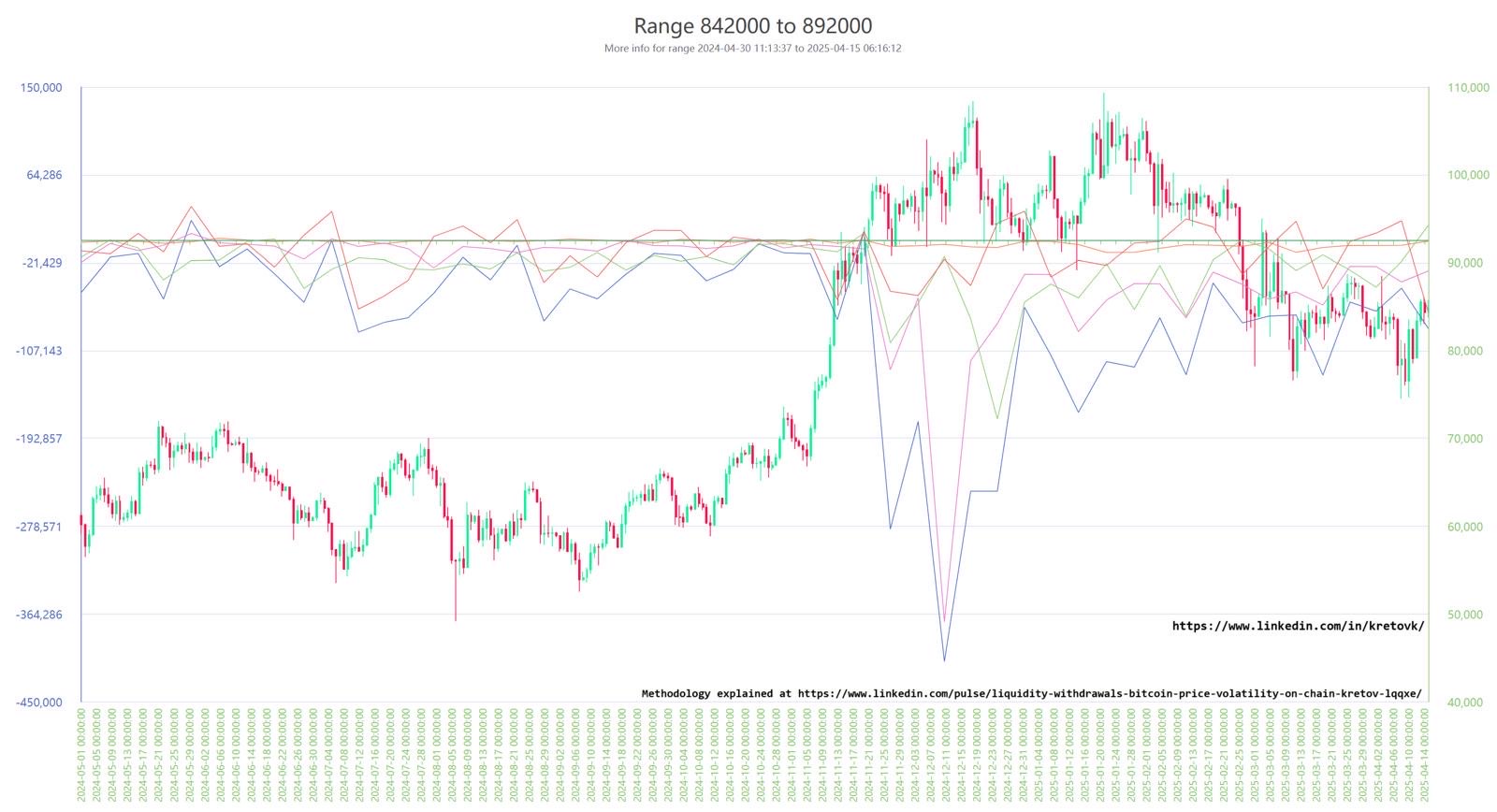
analysis delves deeper into market mechanics. He points to “orchestrated”
patterns: fear-driven sell-offs followed by quiet accumulation by
well-capitalized players. On-chain data reinforces this view, showing a surge
in large Bitcoin outflows (100+ BTC) from exchange wallets since November 2024,
indicating strategic accumulation by whales.
Source: CoinPanel.com
Meanwhile,
smaller transactions (<10 BTC) remain stagnant, reflecting retail investors’
hesitation. “This divergence highlights a market dominated by consolidation at
the top, while smaller participants sit idle,” Kretov notes.
Volatility,
thin liquidity, and weak retail sentiment further complicate the outlook.
Kretov suggests that modest price moves can trigger exaggerated swings, making
Bitcoin vulnerable to manipulation. “A collapse to $10,000 is improbable
without a systemic crisis, but a breakout to $150,000 seems unlikely without
first purging speculative excess,” he says. Instead of a hype-driven rally,
Kretov predicts the next bull run may follow a deep correction that clears out
“dead weight” from retail speculators.
FAQ: Bitcoin Price Outlook
How High Will Bitcoin Go
in 2025?
Analysts
project $145,000–$200,000 by Q4 2025, driven by ETFs and liquidity. Kiyosaki’s
$1 million by 2035 assumes a decade-long crisis but aligns with BTC’s
historical 50%–600% post-halving gains.
Should I Buy Bitcoin Now?
Dips near
$80,000–$82,000 offer better entry points, given historical rebounds. Kiyosaki
urges action: “Those who wait in fear may be the biggest losers.”
How Much Will Bitcoin Be
Worth by 2025?
By year-end
2025, forecasts range from $145,000 (Bitfinex) to $200,000 (Standard
Chartered), with Bernstein citing $150,000 as achievable. Liquidity surges
($6.5 trillion projected) and ETF flows ($70 billion expected) are key drivers.
However, tariff risks or a debt ceiling resolution could cap gains, making
$120,000–$150,000 a realistic target.
What Is the Realistic
Bitcoin Price in 2030?
Predicting
2030 is challenging, but assuming continued adoption and liquidity trends,
Bitcoin could range from $300,000 to $500,000. This accounts for historical
cycle growth (e.g., 600% post-2020 halving), institutional uptake, and
potential U.S. BTC reserves. Kiyosaki’s $1 million by 2035 implies a 2030 price
of $400,000–$600,000 if growth accelerates during economic turmoil.
Geopolitical risks or regulatory shifts could lower this to $200,000.
Will Bitcoin Reach $10
Million?
A $10
million Bitcoin price is highly unlikely, even by 2035. Kiyosaki’s $1 million
forecast assumes a “Greater Depression” and massive fiat devaluation, but $10
million would require unprecedented hyperinflation or global adoption far
beyond current trends. For perspective, $10 million per BTC implies a $200
trillion market cap—over twice the current U.S. GDP. While bullish, this
exceeds realistic scenarios.
What Will Bitcoin Be Worth
in 5 Years’ Time?
By April
2030, Bitcoin could realistically trade between $250,000 and $500,000, driven
by post-2028 halving dynamics, ETF growth, and corporate adoption. Lyn Alden’s
liquidity correlation suggests BTC could benefit from $7 trillion+ in global
liquidity by 2030. Kiyosaki’s $1 million by 2035 implies a 2030 price closer to
$400,000, but macro risks like trade wars could limit it to $200,000.
Renowned
author Robert Kiyosaki forecasts Bitcoin (BTC) price could skyrocket to $1
million by 2035, driven by an ongoing economic crash and surging U.S. debt. As
of today (Saturday), April 19, 2025, Bitcoin’s price is up 1%, trading above $85,000, according to CoinMarketCap. Despite macroeconomic fears, ETF inflows and
bullish sentiment are pushing BTC higher.
In this
article, we dive into Kiyosaki’s bold prediction, explore the forces driving
Bitcoin’s 2025 rally, and answer the critical question: Why is Bitcoin going up
today, and how high can BTC price go in the long run?
Why Is Bitcoin Going Up
Today? BTC Price Back Above 2 Key EMAs
As of April
19, 2025, Bitcoin (BTC) is priced at approximately $85,419, a 1% increase compared
to the previous close and 0.9% over the past 24 hours. The total market
capitalization currently stands at nearly $1.7 trillion, with a daily trading
volume of $12.4 billion.
Bitcoin price today. Source: CoinMarketCap
However,
Robert Kiyosaki, co-author of Rich Dad Poor Dad, believes Bitcoin’s
potential is far greater, projecting a staggering $1 million valuation by 2035.
Why Will Bitcoin Surge?
Kiyosaki’s $1 Million Prediction
In a tweet
posted on April 19, 2025, Kiyosaki warned of a “Greater Depression” fueled by
record-high U.S. debt, rising unemployment, and collapsing 401(k)s. He
reiterated advice from his books, including Rich Dad Poor Dad and Rich
Dad’s Prophecy, urging investors to buy Bitcoin, gold, and silver to
weather the crisis.
MAKES ME SAD: In 2025 credit card debt is at all time highs. US debt is at all time highs. Unemployment is rising. 401 k’s are losing. Pensions are being stolen. USA may be heading for a GREATER DEPRESSION.
I get sad because as I stated in an earlier X….Tweet….I warned…
Economic Collapse as a Catalyst: Kiyosaki points to soaring
U.S. credit card debt, national debt, and pension losses, signaling a
“giant crash.” Historically, economic crises drive demand for scarce
assets like Bitcoin, which has a fixed supply of 21 million coins.
Safe-Haven Appeal: With traditional markets
faltering, Kiyosaki
sees Bitcoin as “digital gold.” Analyst Lyn Alden notes Bitcoin’s 83%
correlation with global liquidity, making it a hedge against fiat
devaluation.
Historical Precedent: Bitcoin surged 600% after the
2020 halving and 150% in 2023’s recovery. The April 2024 halving, reducing
mining rewards to 3.125 BTC, continues to tighten supply, setting the
stage for a bull run.
Market Sentiment: Despite macro fears, buy-side
liquidity on exchanges like Binance remains strong, with large investors
moving BTC to cold storage.
What’s Driving Bitcoin’s
2025 Rally?
Bitcoin’s
current uptrend isn’t just speculative. Several factors are fueling its
momentum:
ETF Inflows: Bitcoin
ETFs have attracted $60 billion in 2025, with retail investors driving
75% of flows. Bernstein analysts project $70 billion more by year-end,
potentially pushing BTC to $150,000.
Easing Macro Pressures: Recent tariff exemptions have
lowered U.S. Treasury yields, reducing headwinds for risk assets like
Bitcoin.
Monetary policy: President Donald Trump didn’t
hesitate to attack Federal Reserve Chair Jerome Powell, hinting at firing
him for “delaying” interest rate cuts
“In my
assessment, Bitcoin crossing the $84,000 threshold was not just a reaction to
Trump’s pressure on Powell; it’s the culmination of months of rising
uncertainty in traditional markets,” commented Rania Gule, Senior Market Analyst at XS.com. “High
interest rates, industrial slowdown, trade tensions, and geopolitical conflicts
are all pushing capital toward havens detached from government influence. Here,
Bitcoin emerges not as a speculative asset, as it was previously labelled, but
as a serious hedge in the eyes of major institutions.”
Bitcoin’s
price action shows a consolidation phase since March 2025, trading between
$87,400 resistance and $78,000 support. The 50-day and 200-day exponential
moving averages (EMAs) have converged near current price levels, signaling a
potential breakout.
My
technical analysis indicates that BTC/USD is currently testing the 50 and 200
EMA levels. If the pair manages to break above them decisively—something that
hasn’t happened in many months—it could generate a strong signal for potential
upward movement.
“Bitcoin's
implied volatility is trending below 50, which is a historically low level, and
price is at the low end of the channel established since November,” said Paul
Howard, Director at Wincent. “Given the turmoil in the macro markets, the last
month hasn't brought BTC price down below 74k (pre-November 2024 levels), and
the regulatory environment is a lot friendlier. It would seem likely we see
price appreciation rather than a gap lower.”
“There
needs to be a catalyst, however, and that might not come for several months and
in my view will be driven by further policy changes in the US, notably regards
to taxation, payments and regulations (specifically on stablecoins).”
Bullish
Case: A break above
$86,000 could target:
$90,000–$92,000
(late 2024 lows)
$100,000
(psychological level)
$108,000
(December 2024 all-time high)
$150,000 (potential Q4 2025
target, per Bernstein)
Bearish
Case: A drop below
$78,000 could test:
$74,500
(April 2025 lows)
$68,000
(July 2024 highs)
$66,000
(October 2024 lows)
Support and Resistance Levels:
Support Levels
Description
Resistance Levels
Description
$78,000
Lower
consolidation boundary, tested in March 2025
$87,400
Upper
consolidation boundary, March 2025 highs
$74,500
April 2025 lows
$90,000–$92,000
Resistance from late 2024 lows
$68,000
July 2024 highs
$100,000
Psychological barrier
$66,000
October 2024 lows
$108,000
December 2024 all-time high
Bitcoin Price Predictions
for 2025 and Beyond
Kiyosaki’s
$1 million by 2035 is ambitious, but other analysts offer nearer-term
forecasts:
Kiyosaki’s
$1 million call assumes a prolonged crisis, but risks could derail Bitcoin’s
ascent:
Debt Ceiling Resolution: An early debt ceiling deal
could slow TGA drawdowns, capping liquidity at $6.3 trillion, per Tomas.
Geopolitical Tensions: Escalating global conflicts
could favor gold over Bitcoin
Technical Hurdles: Failure to break the 200-day
EMA could trap BTC below $90,000, delaying bullish momentum.
Moreover, Dr.
Kirill Kretov, Senior Automation Expert at CoinPanel, offers a more cautious
outlook. In a recent statement, Kretov warns that the bullish narrative may
overlook critical macroeconomic and market dynamics, casting doubt on a clean
breakout to six-figure prices in 2025.
“We are in
a phase of deep macro uncertainty marked by geopolitical tension, fragile
global markets, and a strong risk-off sentiment,” Kretov explains. He argues
that Bitcoin is behaving more like a speculative asset than the “digital gold”
Kiyosaki champions. In this climate, traditional safe-haven assets like gold
are regaining prominence, potentially siphoning demand from BTC.
Kretov’s
analysis delves deeper into market mechanics. He points to “orchestrated”
patterns: fear-driven sell-offs followed by quiet accumulation by
well-capitalized players. On-chain data reinforces this view, showing a surge
in large Bitcoin outflows (100+ BTC) from exchange wallets since November 2024,
indicating strategic accumulation by whales.
Source: CoinPanel.com
Meanwhile,
smaller transactions (<10 BTC) remain stagnant, reflecting retail investors’
hesitation. “This divergence highlights a market dominated by consolidation at
the top, while smaller participants sit idle,” Kretov notes.
Volatility,
thin liquidity, and weak retail sentiment further complicate the outlook.
Kretov suggests that modest price moves can trigger exaggerated swings, making
Bitcoin vulnerable to manipulation. “A collapse to $10,000 is improbable
without a systemic crisis, but a breakout to $150,000 seems unlikely without
first purging speculative excess,” he says. Instead of a hype-driven rally,
Kretov predicts the next bull run may follow a deep correction that clears out
“dead weight” from retail speculators.
FAQ: Bitcoin Price Outlook
How High Will Bitcoin Go
in 2025?
Analysts
project $145,000–$200,000 by Q4 2025, driven by ETFs and liquidity. Kiyosaki’s
$1 million by 2035 assumes a decade-long crisis but aligns with BTC’s
historical 50%–600% post-halving gains.
Should I Buy Bitcoin Now?
Dips near
$80,000–$82,000 offer better entry points, given historical rebounds. Kiyosaki
urges action: “Those who wait in fear may be the biggest losers.”
How Much Will Bitcoin Be
Worth by 2025?
By year-end
2025, forecasts range from $145,000 (Bitfinex) to $200,000 (Standard
Chartered), with Bernstein citing $150,000 as achievable. Liquidity surges
($6.5 trillion projected) and ETF flows ($70 billion expected) are key drivers.
However, tariff risks or a debt ceiling resolution could cap gains, making
$120,000–$150,000 a realistic target.
What Is the Realistic
Bitcoin Price in 2030?
Predicting
2030 is challenging, but assuming continued adoption and liquidity trends,
Bitcoin could range from $300,000 to $500,000. This accounts for historical
cycle growth (e.g., 600% post-2020 halving), institutional uptake, and
potential U.S. BTC reserves. Kiyosaki’s $1 million by 2035 implies a 2030 price
of $400,000–$600,000 if growth accelerates during economic turmoil.
Geopolitical risks or regulatory shifts could lower this to $200,000.
Will Bitcoin Reach $10
Million?
A $10
million Bitcoin price is highly unlikely, even by 2035. Kiyosaki’s $1 million
forecast assumes a “Greater Depression” and massive fiat devaluation, but $10
million would require unprecedented hyperinflation or global adoption far
beyond current trends. For perspective, $10 million per BTC implies a $200
trillion market cap—over twice the current U.S. GDP. While bullish, this
exceeds realistic scenarios.
What Will Bitcoin Be Worth
in 5 Years’ Time?
By April
2030, Bitcoin could realistically trade between $250,000 and $500,000, driven
by post-2028 halving dynamics, ETF growth, and corporate adoption. Lyn Alden’s
liquidity correlation suggests BTC could benefit from $7 trillion+ in global
liquidity by 2030. Kiyosaki’s $1 million by 2035 implies a 2030 price closer to
$400,000, but macro risks like trade wars could limit it to $200,000.
Damian Chmiel is a Senior Analyst & Editor at Finance Magnates with more than 15 years of experience in the CFD and online trading industry. Active as both a trader and journalist since 2010, he focuses on broker coverage, fintech innovation, and regulatory developments across Europe, the Middle East, and Asia.
His work includes interviews with C-level leaders at major brokerages and fintech platforms, as well as co-authoring Finance Magnates’ quarterly industry benchmarking reports. Damian’s reporting is data-driven, market-aware, and grounded in direct industry engagement. His analysis and commentary have also been cited by external media outlets, including Investing.com, Binance, The Asset, Stockhead, and Dispatch.
Education:
MA in Finance and Accounting, Cracow University of Economics
How Low Can Silver Price Go? The New XAG/USD Analysis Suggests -50% Bearish Targer
Featured Videos
FM Daily Brief – 16 July 2026
FM Daily Brief – 16 July 2026
FM Daily Brief – 16 July 2026
FM Daily Brief – 16 July 2026
Today's Thursday, the 16th of July 2026, and these are our main stories: Cyprus authorities dismantle a major crypto investment fraud network, Eightcap brings its simulated trading challenges to TradingView, and Belgium reports a sharp fall in WhatsApp stock-tip fraud losses.
Today's Thursday, the 16th of July 2026, and these are our main stories: Cyprus authorities dismantle a major crypto investment fraud network, Eightcap brings its simulated trading challenges to TradingView, and Belgium reports a sharp fall in WhatsApp stock-tip fraud losses.
Today's Thursday, the 16th of July 2026, and these are our main stories: Cyprus authorities dismantle a major crypto investment fraud network, Eightcap brings its simulated trading challenges to TradingView, and Belgium reports a sharp fall in WhatsApp stock-tip fraud losses.
Today's Thursday, the 16th of July 2026, and these are our main stories: Cyprus authorities dismantle a major crypto investment fraud network, Eightcap brings its simulated trading challenges to TradingView, and Belgium reports a sharp fall in WhatsApp stock-tip fraud losses.
We asked finance executives one question:
"What's your number one success tip?"
Their answers all pointed in the same direction: build trust, respond quickly and put relationships first.
Featuring Lux Thiagarajah (OpenPayd), Scott Chiriaco (PropAccount.com) and Tatjana Meluskane (SPAYZ.io).
#FinanceMagnates #CustomerSuccess #B2B #Fintech #Shorts
We asked finance executives one question:
"What's your number one success tip?"
Their answers all pointed in the same direction: build trust, respond quickly and put relationships first.
Featuring Lux Thiagarajah (OpenPayd), Scott Chiriaco (PropAccount.com) and Tatjana Meluskane (SPAYZ.io).
#FinanceMagnates #CustomerSuccess #B2B #Fintech #Shorts
We asked finance executives one question:
"What's your number one success tip?"
Their answers all pointed in the same direction: build trust, respond quickly and put relationships first.
Featuring Lux Thiagarajah (OpenPayd), Scott Chiriaco (PropAccount.com) and Tatjana Meluskane (SPAYZ.io).
#FinanceMagnates #CustomerSuccess #B2B #Fintech #Shorts
We asked finance executives one question:
"What's your number one success tip?"
Their answers all pointed in the same direction: build trust, respond quickly and put relationships first.
Featuring Lux Thiagarajah (OpenPayd), Scott Chiriaco (PropAccount.com) and Tatjana Meluskane (SPAYZ.io).
#FinanceMagnates #CustomerSuccess #B2B #Fintech #Shorts
We asked finance executives one question:
"What's your number one success tip?"
Their answers all pointed in the same direction: build trust, respond quickly and put relationships first.
Featuring Lux Thiagarajah (OpenPayd), Scott Chiriaco (PropAccount.com) and Tatjana Meluskane (SPAYZ.io).
#FinanceMagnates #CustomerSuccess #B2B #Fintech #Shorts
We asked finance executives one question:
"What's your number one success tip?"
Their answers all pointed in the same direction: build trust, respond quickly and put relationships first.
Featuring Lux Thiagarajah (OpenPayd), Scott Chiriaco (PropAccount.com) and Tatjana Meluskane (SPAYZ.io).
#FinanceMagnates #CustomerSuccess #B2B #Fintech #Shorts
Base Markets CEO: Why Trust Matters More Than Bonuses | Alex Kolpokchi Interview
Base Markets CEO: Why Trust Matters More Than Bonuses | Alex Kolpokchi Interview
Base Markets CEO: Why Trust Matters More Than Bonuses | Alex Kolpokchi Interview
Base Markets CEO: Why Trust Matters More Than Bonuses | Alex Kolpokchi Interview
Base Markets CEO: Why Trust Matters More Than Bonuses | Alex Kolpokchi Interview
Base Markets CEO: Why Trust Matters More Than Bonuses | Alex Kolpokchi Interview
Is it still possible to build a successful brokerage by putting clients first instead of relying on flashy promotions?
In this exclusive Finance Magnates Executive Interview, Yam Yehoshua, Chief Editor at Finance Magnates, sits down with Alex Kolpokchi, Co-Founder & CEO of Base Markets, to discuss the company's vision, the lessons learned from leading brokers, and why trust, transparency and real client value are at the centre of its strategy.
During the interview, Alex shares:
- How his experience at IG and Pepperstone shaped Base Markets
- Why the company describes itself as a "no-nonsense broker"
- The importance of trust, execution and client service
- How real client feedback helped build the platform
- Why Base Markets avoided a traditional public launch
- The company's long-term plans for regulation and growth
What makes Base Markets different in today's competitive brokerage industry
💬 What do you think matters most when choosing a broker—pricing, execution, regulation or customer service? Let us know in the comments.
#BaseMarkets #Forex #CFDTrading #OnlineTrading #Brokerage #Trading #FinanceMagnates #Fintech #CEOInterview #TradingIndustry
Is it still possible to build a successful brokerage by putting clients first instead of relying on flashy promotions?
In this exclusive Finance Magnates Executive Interview, Yam Yehoshua, Chief Editor at Finance Magnates, sits down with Alex Kolpokchi, Co-Founder & CEO of Base Markets, to discuss the company's vision, the lessons learned from leading brokers, and why trust, transparency and real client value are at the centre of its strategy.
During the interview, Alex shares:
- How his experience at IG and Pepperstone shaped Base Markets
- Why the company describes itself as a "no-nonsense broker"
- The importance of trust, execution and client service
- How real client feedback helped build the platform
- Why Base Markets avoided a traditional public launch
- The company's long-term plans for regulation and growth
What makes Base Markets different in today's competitive brokerage industry
💬 What do you think matters most when choosing a broker—pricing, execution, regulation or customer service? Let us know in the comments.
#BaseMarkets #Forex #CFDTrading #OnlineTrading #Brokerage #Trading #FinanceMagnates #Fintech #CEOInterview #TradingIndustry
Is it still possible to build a successful brokerage by putting clients first instead of relying on flashy promotions?
In this exclusive Finance Magnates Executive Interview, Yam Yehoshua, Chief Editor at Finance Magnates, sits down with Alex Kolpokchi, Co-Founder & CEO of Base Markets, to discuss the company's vision, the lessons learned from leading brokers, and why trust, transparency and real client value are at the centre of its strategy.
During the interview, Alex shares:
- How his experience at IG and Pepperstone shaped Base Markets
- Why the company describes itself as a "no-nonsense broker"
- The importance of trust, execution and client service
- How real client feedback helped build the platform
- Why Base Markets avoided a traditional public launch
- The company's long-term plans for regulation and growth
What makes Base Markets different in today's competitive brokerage industry
💬 What do you think matters most when choosing a broker—pricing, execution, regulation or customer service? Let us know in the comments.
#BaseMarkets #Forex #CFDTrading #OnlineTrading #Brokerage #Trading #FinanceMagnates #Fintech #CEOInterview #TradingIndustry
Is it still possible to build a successful brokerage by putting clients first instead of relying on flashy promotions?
In this exclusive Finance Magnates Executive Interview, Yam Yehoshua, Chief Editor at Finance Magnates, sits down with Alex Kolpokchi, Co-Founder & CEO of Base Markets, to discuss the company's vision, the lessons learned from leading brokers, and why trust, transparency and real client value are at the centre of its strategy.
During the interview, Alex shares:
- How his experience at IG and Pepperstone shaped Base Markets
- Why the company describes itself as a "no-nonsense broker"
- The importance of trust, execution and client service
- How real client feedback helped build the platform
- Why Base Markets avoided a traditional public launch
- The company's long-term plans for regulation and growth
What makes Base Markets different in today's competitive brokerage industry
💬 What do you think matters most when choosing a broker—pricing, execution, regulation or customer service? Let us know in the comments.
#BaseMarkets #Forex #CFDTrading #OnlineTrading #Brokerage #Trading #FinanceMagnates #Fintech #CEOInterview #TradingIndustry
Is it still possible to build a successful brokerage by putting clients first instead of relying on flashy promotions?
In this exclusive Finance Magnates Executive Interview, Yam Yehoshua, Chief Editor at Finance Magnates, sits down with Alex Kolpokchi, Co-Founder & CEO of Base Markets, to discuss the company's vision, the lessons learned from leading brokers, and why trust, transparency and real client value are at the centre of its strategy.
During the interview, Alex shares:
- How his experience at IG and Pepperstone shaped Base Markets
- Why the company describes itself as a "no-nonsense broker"
- The importance of trust, execution and client service
- How real client feedback helped build the platform
- Why Base Markets avoided a traditional public launch
- The company's long-term plans for regulation and growth
What makes Base Markets different in today's competitive brokerage industry
💬 What do you think matters most when choosing a broker—pricing, execution, regulation or customer service? Let us know in the comments.
#BaseMarkets #Forex #CFDTrading #OnlineTrading #Brokerage #Trading #FinanceMagnates #Fintech #CEOInterview #TradingIndustry
Is it still possible to build a successful brokerage by putting clients first instead of relying on flashy promotions?
In this exclusive Finance Magnates Executive Interview, Yam Yehoshua, Chief Editor at Finance Magnates, sits down with Alex Kolpokchi, Co-Founder & CEO of Base Markets, to discuss the company's vision, the lessons learned from leading brokers, and why trust, transparency and real client value are at the centre of its strategy.
During the interview, Alex shares:
- How his experience at IG and Pepperstone shaped Base Markets
- Why the company describes itself as a "no-nonsense broker"
- The importance of trust, execution and client service
- How real client feedback helped build the platform
- Why Base Markets avoided a traditional public launch
- The company's long-term plans for regulation and growth
What makes Base Markets different in today's competitive brokerage industry
💬 What do you think matters most when choosing a broker—pricing, execution, regulation or customer service? Let us know in the comments.
#BaseMarkets #Forex #CFDTrading #OnlineTrading #Brokerage #Trading #FinanceMagnates #Fintech #CEOInterview #TradingIndustry
FM Daily Brief – 15 July 2026
FM Daily Brief – 15 July 2026
FM Daily Brief – 15 July 2026
FM Daily Brief – 15 July 2026
FM Daily Brief – 15 July 2026
FM Daily Brief – 15 July 2026
Today's Wednesday, the 15th of July 2026, and these are our main stories: CMC Markets expands 24/5 US trading to more than 5,000 shares and ETFs, Tickmill UK partners with Interactive Brokers, and Revolut moves closer to launching crypto services in the UAE.
Today's Wednesday, the 15th of July 2026, and these are our main stories: CMC Markets expands 24/5 US trading to more than 5,000 shares and ETFs, Tickmill UK partners with Interactive Brokers, and Revolut moves closer to launching crypto services in the UAE.
Today's Wednesday, the 15th of July 2026, and these are our main stories: CMC Markets expands 24/5 US trading to more than 5,000 shares and ETFs, Tickmill UK partners with Interactive Brokers, and Revolut moves closer to launching crypto services in the UAE.
Today's Wednesday, the 15th of July 2026, and these are our main stories: CMC Markets expands 24/5 US trading to more than 5,000 shares and ETFs, Tickmill UK partners with Interactive Brokers, and Revolut moves closer to launching crypto services in the UAE.
Today's Wednesday, the 15th of July 2026, and these are our main stories: CMC Markets expands 24/5 US trading to more than 5,000 shares and ETFs, Tickmill UK partners with Interactive Brokers, and Revolut moves closer to launching crypto services in the UAE.
Today's Wednesday, the 15th of July 2026, and these are our main stories: CMC Markets expands 24/5 US trading to more than 5,000 shares and ETFs, Tickmill UK partners with Interactive Brokers, and Revolut moves closer to launching crypto services in the UAE.
FM Daily Brief – 14 July 2026
FM Daily Brief – 14 July 2026
FM Daily Brief – 14 July 2026
FM Daily Brief – 14 July 2026
FM Daily Brief – 14 July 2026
FM Daily Brief – 14 July 2026
Today's Tuesday, the 14th of July 2026, and these are our main stories: NinjaTrader cuts ties with Alpha Futures, Russia opens regulated crypto CFDs, and ActivTrades reshapes its group structure.
Today's Tuesday, the 14th of July 2026, and these are our main stories: NinjaTrader cuts ties with Alpha Futures, Russia opens regulated crypto CFDs, and ActivTrades reshapes its group structure.
Today's Tuesday, the 14th of July 2026, and these are our main stories: NinjaTrader cuts ties with Alpha Futures, Russia opens regulated crypto CFDs, and ActivTrades reshapes its group structure.
Today's Tuesday, the 14th of July 2026, and these are our main stories: NinjaTrader cuts ties with Alpha Futures, Russia opens regulated crypto CFDs, and ActivTrades reshapes its group structure.
Today's Tuesday, the 14th of July 2026, and these are our main stories: NinjaTrader cuts ties with Alpha Futures, Russia opens regulated crypto CFDs, and ActivTrades reshapes its group structure.
Today's Tuesday, the 14th of July 2026, and these are our main stories: NinjaTrader cuts ties with Alpha Futures, Russia opens regulated crypto CFDs, and ActivTrades reshapes its group structure.